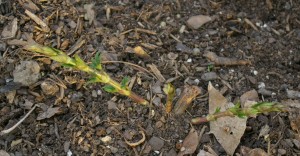
Today I Hate Squirrels

posted on April 19, 2010 at 11:11 pm by Ken Valley in Homebrewing

Today during lunch, I dug through my recently planted Cascade hops, and I had a disconcerting find.  One of my rhizomes was missing.  At first, I thought I may have missed it, so I dug through the soil again, and couldn’t find it.

At this point, I thought about when I had last checked the rhizomes.  It was Saturday evening, and everything was good.  With both of the rhizomes, I took a couple of the sprouts and placed them above ground to reach the sun, to hopefully kick-start the growth cycle.  Perhaps the birds thought it was a worm and grabbed it out of the ground.  Then I remembered the dreaded squirrels liked to dig through my soil, mentioned in my last hops growing article.

I searched the yard, about 10-15 feet from the bed, and found the rhizome.  It had been split in half and chewed, most likely by squirrels.  I was devastated.  I decided to first soak what was left of the rhizome in some water, then buried the halves in the soil.  To try and repel the squirrels, I spread black pepper and cayenne pepper over the beds.

So, let’s hope for the best so the rhizome will grow, and today I hate squirrels.

Boulevard Boss Tom’s Golden Bock

posted on April 18, 2010 at 10:47 pm by Ken Valley in Beer Reviews,Craft Beer

Boss Tom's Golden Bock

Boss Tom's Golden Bock

Tonight I had the chance to try Boulevard Brewing’s late spring seasonal offering, Boss Tom’s Golden Bock.

It was straw-colored, and had just a hint of caramel aroma.  Tasting it, there was a slight malt and bread flavor with a caramel finish.  It has little hop flavor and aroma.

I applaud Boulevard for trying a “late spring” seasonal.  I hope to see it again next year.

Have you tried Boss Tom’s Golden Bock?  What did you think?

Newton’s New “Madhouse Brewery” and Free Beer

posted on April 16, 2010 at 3:16 pm by Ken Valley in Craft Beer

About a month ago, a new Iowa brewery started in Newton: Madhouse Brewing.  The brewery is currently located in the old Maytag factory in Newton, where the Maytag company was housed for over 100 years until 2007.  The initial offerings are Madhouse American Wheat and Pastime American Pale Ale.  The brewery is having an open house this Saturday, April 17, from 12-6, and will be offering free tastings of the beer.  If you get a chance, head on over to Newton, and support the newest Iowa brewery!

Growing Hops in Iowa Part 2 – The Beginning

posted on April 15, 2010 at 11:47 pm by Ken Valley in Homebrewing

Early Hop Plant

Early Hop Plant

As you bring out your green thumb and decide to plant your own hops, here are the things you need to get started:

  1. Hop Rhizomes (obviously)
  2. A trellis system for the hops to climb
  3. Dirt (another obvious item)
  4. Protection from critters (this is optional, but I found out quickly that squirrels like to dig in the loose soil)

Let’s start by discussing each item one by one.  First, hop rhizomes are a section of the root of another hop plant.  What’s nice about rhizomes is they shoot off additional rhizomes each year, and those offshoots can be dug up and replanted, or given to friends.  As a matter of fact, that’s how the original rhizomes are harvested, and each one is genetically identical to the parent.  Each year around February or March, many homebrewing stores sell rhizomes to plant.  Unfortunately, if you miss this window, you may need to wait until next year to obtain a rhizome.  If you remember from my previous article on growing hops, last year I purchased Goldings, Tettenang, and Willamette hop varieties.  This year, I expanded my hop selection to five by also purchasing Hallertau and Cascade.  As of right now, the Tettenang hops are growing very well, and a couple of bines are over 2 foot tall.  I just planted the two new varieties this evening, but have heard good stories about how well Cascade hops grow in the Midwest.

Tying Up Hop Strings

Tying Up Hop Strings on the Trellis

Now that you’ve obtained the hops, the next step is to build some kind of a trellis system for the hops to grow.  There are numerous designs available, but, from the photo, you can see that I went with PVC pipes.  I found this design on the internet, but have had a hard time finding it again.  If you want details, let me know.

Each one is spaced 8 feet apart, and the PVC is 10+ feet high.  I have three eyelets for each vertical pipe, spaced 2-3 feet apart, screwed into the top pipe, and have strings tied to each eyelet.  Then, on the ground, I have a spike I tie the strings to.

The reason I went with this design is that if you notice at the bottom of the pipes there is a dark gray pipe sunk into the ground.  It is a bit larger in diameter than the white pipes, and each white pipe slides into the gray pipe.  This allows me to remove the white PVC pipes and store them for the winter with only the dark gray pipes staying outside all year.

Now that we have the rhizomes and the trellis, we need to plant.  You can simply place the rhizomes into the dirt and allow them to grow, or you can make the soil more hospitable.  For the most part, there are few nutrients needed, but I dig a hole and use garden soil or potting soil.  Some folks use regular soil mixed with manure.  I also use a liquid fertilizer.  Because the soil is loose to allow for water drainage, it’s advisable to put a fence around it to keep the local squirrels and chipmunks from digging in the dirt, thinking they left nuts from the winter buried in your hop bed.

So, that’s about all you need to plant hops.  They are hardy plants that just need a little attention and patience, and with time, you will have your own hops.  Look for my progress updates as growing season progresses.

What’s your experience with growing hops?  Have you had success where you live?

Samuel Adams Latitude 48

posted on April 13, 2010 at 10:54 pm by Ken Valley in Beer Reviews,Craft Beer

Samuel Adams Latitude 48

Samuel Adams Latitude 48

As part of the Summer Mix Pack, Samuel Adams debuted their new IPA, Latitude 48.  It is called Latitude 48 because the American, English, and German hops added are all found around the 48th parallel.

At first, Latitude 48 smells very floral and citrusy, and was a darker red color. At first, it is sweeter than expected, and has a strong hop character. With the taste, I couldn’t pin down which hops were used, but I tasted citrus, pine, and a bit of earthy hop flavors.  My impression was that it was sweet but not overly bitter. It was quite an enjoyable IPA.

Have you tried the Latitude 48?  What did you think?

« Previous — Next »